Critters

by Nina Lundstrom

Editor’s Note: Nina Lundstrom has been working with us since July 2017 and was a core member of our beach seining team over the summer. She arrived in Alaska already a seasoned seiner, having learned the tools of the trade during her internship in the San Juan Islands, Washington, the summer after graduating with a degree in biology and ecology from Colorado College. In this post, Nina writes about her work with the Kwiaht Center for the Historical Ecology of the Salish Sea and the people and places she got to know. Incidentally, I (Anne) also worked with Kwiaht nearly a decade earlier and helped train volunteers in the delicate art of inducing fish to regurgitate their meals (for science!). I was proud to be there at the start of the wonderful citizen science monitoring program that continues today. Nina’s story perfectly captures the feeling of working in the islands.

♦♦♦

“You have to see this picture I just took of the most gorgeous little earwig, sipping on some Yarro nectar!” My boss, Russel Barsh, had just come pounding down the trail towards me, brandishing his camera and looking nothing short of gleeful. This was undoubtedly the first time in my life anyone had ever used the words gorgeous and earwig sequentially. I stood up, brushing dirt off the knees of my pants, and took the camera, Russel still gazing lovingly at the photo. Through the course of the summer, I would get used to these reverential descriptions of some arguably repulsive creatures. It takes a special kind of person to see the beauty in something like a clam worm: a sickly pink annelid that moves like a cross between a snake and a centipede and can administer a nasty bite to the unsuspecting clam digger, but Russel had a gift for recognizing the nuances and charm in just about every living thing.

I was living and working on Lopez Island off the coast of Washington, and there was no difficulty in recognizing the nuances and charm of the place itself. The island was small, only 15 miles long and 8 miles wide. One main road ran from end to end, appropriately named Center Road. The island was covered in thick forests of douglas fir, some of which were over 500 years old, and each edge of the island looked out on Mount Baker, or the Olympic Mountains, or the Cascades, depending on where you stood. I was a research apprentice for Russel and his partner Madrona Murphy, the directors of a non-profit research organization, Kwiaht. I worked seven days a week, between six and twelve hours a day, split evenly between the field and the lab. My primary project involved fish genetics, but my daily tasks ranged from digging up square meters of frozen muck and determining the species and ages of the clams living in said muck, to monitoring the comings and goings of the bees on wild blackberries. Russel and Madrona had an unparalleled love for their jobs and for the natural world, and I never got the impression that the hours we spent collecting data felt like work to them.

The best days were the “seining days” on Waldron and Lopez islands. Russel, Madrona, several buckets of equipment, and I would load up into a 20 foot boat driven by the designated boatman of the day, my favorite of whom was Tom*. Tom was a middle-aged man who always wore Wrangler jeans tucked into his Wellingtons and cheerfully passed his time on the boat, fishing for lingcod while we worked. He loved to rant about the fishing industry and “the bureaucracy,” and he shared his freshly trapped Dungeness crabs with me. He would motor us to Waldron Island or the south side of Lopez, where we would set up the net, a contraption 120 feet long and six feet deep, with floats on the top and weights on the bottom. The boat would pull one end in an arc through the bay and back to shallow water. There, someone on each end would swim out and grab it and pull it in with the somewhat unwilling help of strangers who had unknowingly picked our research spot on the beach as their relaxation location. The minutes following the pull were nothing short of chaotic, as we held the net in the water and sifted through its occupants. I grew accustomed to blindly plunging my hand into the depths of the submerged net to grab a jellyfish, a crab, or a sculpin that could harm one of the smaller fish or, consequently, my fingers. These predators were casually tossed over our shoulders and swam happily away. Russel and Madrona both possessed an incredible ability to snatch swimming fish out of the water with their bare hands and identify them with a single glance. We counted and released gunnels, sticklebacks, perch, flounder, snake pricklebacks, pipefish, pink salmon and chum salmon, but temporarily kept the king salmon to extract their stomach contents.

*name changed for this story

OLYMPUS DIGITAL CAMERA

Beach seining on Lopez Island. Photo by Chris Sergeant.

It was easy to fall in love with king salmon, or Chinooks, as a species. The fish we studied were only about five days out of the river in which they were born, and they were charming and beautiful babies. Their glowing green backs sported cheetah-like black spots, and they swam less with their tails than with their tiny pectoral fins, alternating strokes. Most of them still had their par marks, perfectly spaced oval spots running down their sides, signifying their young age. We cheered for the fish whose stomach contents were full of smaller fish, and gently encouraged the ones who had only eaten an insect or two. I have never seen a pair of people so connected to and invested in fish vomit, but Russel and Madrona’s love for the Chinooks was infectious. Russel cooed to each individual fish, practically cuddling it as he plunged a blunt ended syringe down its throat to collect stomach contents. I was taught to perform “fish CPR” if any began to float, and someone was always closely watching the “recovery bucket” to ensure the well-being of the salmon. We didn’t have a single fatality all summer.

Chinook salmon_photo courtesy of Nina Lundstrom

Performing gastric lavage (left) and taking a small fin clip (right) from a juvenile Chinook salmon. Photos courtesy of Nina Lundstrom.

On one exhausting day, the first pull of the net yielded only smelt, a silvery fish that is a popular food source for island residents. A second net pull brought in herring, their rainbow scales flashing in the sunlight. A third pull seemed pointless and time-consuming on an already long day, but we did it anyway. Much to our surprise, thirty sizeable Chinooks were brought in, and we set up our “lavage station.” As we started our machine-like process of measurement, fin clip, scale collection, gut lavage, and recovery bucket, Russel whispered lovingly to one particularly large fish, “Oh, you are a little fatty aren’t you?” I did my best to disguise my laughter as a coughing fit.

My job was to sift through the stomach contents of each salmon and collect the sand lance, a small needle-nosed fish often eaten by juvenile Chinooks. I then extracted their DNA, amplified it with a set of primers (known gene sequences), and ran it through the genetic sequencer to try to formulate a population structure. It initially sounded like a straightforward process, and I dove in enthusiastically. Eight weeks of viciously whispered profanities followed. The monstrous machine had daily malfunctions, and as soon as things seemed to be running smoothly, some outside factor would throw the data off, forcing me to start over. Twice during the summer, all of the power in the school went out because of ongoing construction, and the whole machine crashed. All of the frozen polymers, buffers, and primers defrosted, became useless, and had to be reordered. While we waited for them to be shipped, I got the pleasant task of sorting through bags of poorly preserved dead fish, some of which had been partially decaying for three years. Oh, how I longed to work on the horrible machine in those days.

Seining on Waldron_photo by Nina Lundstrom

Setting up the beach seine on Waldron Island, a northern neighbor of Lopez Island in the San Juan Archipelago, Washington. Photo by Nina Lundstrom.

Near the end of my time on Lopez, Russel, Madrona, and I went out to the spit to check on some oysters that had been planted there the year before. We were knee deep in mud, cutting into the oyster bags to count the living and the dead. In the span of a year, the bags had become tiny ecosystems, kelp growing on the outsides and critters making their homes among the oyster colonies. Several crabs had crawled through the plastic mesh when they were small, made their homes, and grew too large to ever leave. They showed their appreciation for our rescue mission by vigorously pinching us as we returned them to the ocean. Russel opened one shell to find a spaghetti worm camping out in the enclosed space. Spaghetti worms are small and dark pink, with seemingly endless tentacle feelers that closely resemble angel hair pasta. They are the stuff of Fear Factor, the antithesis of charming. Russel beamed down at the worm. “You wonderful, smart spaghetti worm, how innovative of you to make your home in that shell,” he crooned. I turned back to my oysters, grinning.

Several hours later, hands caked in mud, and feet sunk fully and permanently into the mud, I found another shell housing a spaghetti worm. I released the worm into the water and watched it sink to the bottom and crawl away. “Good little spaghetti worm,” I whispered, in spite of myself.

Nina Lundstrom with sculpin_photo by Doug Duncan

Nina with one of the critters we love in Juneau, Alaska. Photo by Doug Duncan.
Things we’re thankful for

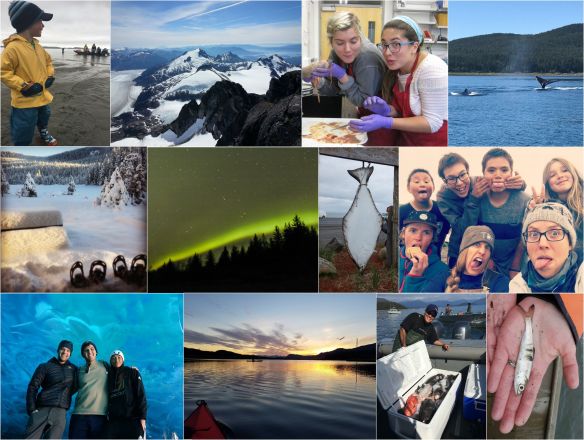
In honor of Thanksgiving, the Coastal Fisheries Ecology Lab took a moment to reflect on the many things we are thankful for.

Thanksgiving Collage.jpg

We are thankful for the scientific adventures waiting right outside our door and the people we get to share them with. ♦ We are thankful for the new experiences and amazing opportunities that Alaska has to offer. ♦ We’re thankful for the absolutely wonderful people that we’ve gotten to know while working with Juneau’s fishing community. The generosity they’ve shown with their time, knowledge, and resources have greatly improved our research. ♦ We are grateful to share our love of science with students of all ages, who make us feel forever young at heart with their endless energy, curiosity, wonder, and joy. ♦ We’re thankful for the continued enthusiasm of research assistants who have helped out in field and lab. ♦ We are thankful for the wonderful group of people we’ve had the chance to work with in the course of our research. ♦ We’re thankful that we get to live in a pristine place with such a presence of wilderness. ♦ We are thankful for the hospitality and warmth of Alaska and its people. ♦ We are thankful for the kind and generous people and breathtaking landscapes that make Juneau home. ♦ We are thankful for the wonderful people and beautiful places that fill our lives with happiness.

Happy Thanksgiving to all of our colleagues, friends, and family across the world!

-Anne, Cheryl, Doug, Joe, Maggie, Matt, Nina, Rhea, and Veronica

A 5-star field extravaganza!

by Anne Beaudreau

There are many measures of success in fieldwork. The first, and most obvious, is whether you catch fish. They can’t just be any fish; they have to be the right fish to meet your study objectives. A second measure of success is whether the crew gets along. Luckily, most everyone I know in the field of fisheries loves to be outdoors. But you never know how personalities and expectations will mesh when everyone is wet and cold. Of course, the most important measure of success is whether everyone stays safe (and staying safe also means protecting the boat!).

Since 2012, the Coastal Fisheries Ecology lab has been studying the ecology of juvenile sablefish. Two weeks ago, before our team left for Sitka to begin a new phase of our sablefish field research, we were facing a lot of unknowns: Would we catch fish? NOAA researchers had caught juvenile sablefish in October during the 1980s and 1990s, but that was a while ago and every year is different. Would the weather hold up? This was fall in Southeast Alaska after all. Wind could be a real threat. Would there be any issues with the rental boat? We were pretty sure that the 22-foot Hewescraft would be just what we needed to get the work done, but hadn’t worked with the company before.

Pre-fieldwork uncertainty can be stressful. But uncertainty brings with it the promise of discovery, of seeing something new even in a place you have visited countless times, of learning something about the system you are studying. So, how did we do? Were we successful? If you read the title of this post, you’ll probably guess the answer: a 5-star week on all counts! Here’s a recap of the highlights, with reflections from the whole crew.

SJBB Scenery_courtesy of CFE Lab.JPG

The quest for sablefish begins. Even when it’s overcast, raining, or sleeting, St. John Baptist Bay is an idyllic place.

Catching the right fish and learning on the job

We were hoping to catch a range of ages and sizes, to understand whether young sablefish at different life stages store energy differently before they enter the lean winter months. Matt Callahan, the lead MS student on the project, and I had been planning this work for months and were eager to find out if, in fact, we would catch the “right fish.” Within the first moments of fishing we had our answer. As Matt said,

The most memorable aspect for me was the first day, or really the first thirty seconds of fishing. After months of planning and uncertainty as to whether we’d even catch fish, we finally put our hooks in the water and BAM! Our hooks barely hit bottom before getting swarmed with hungry, hungry sablefish.

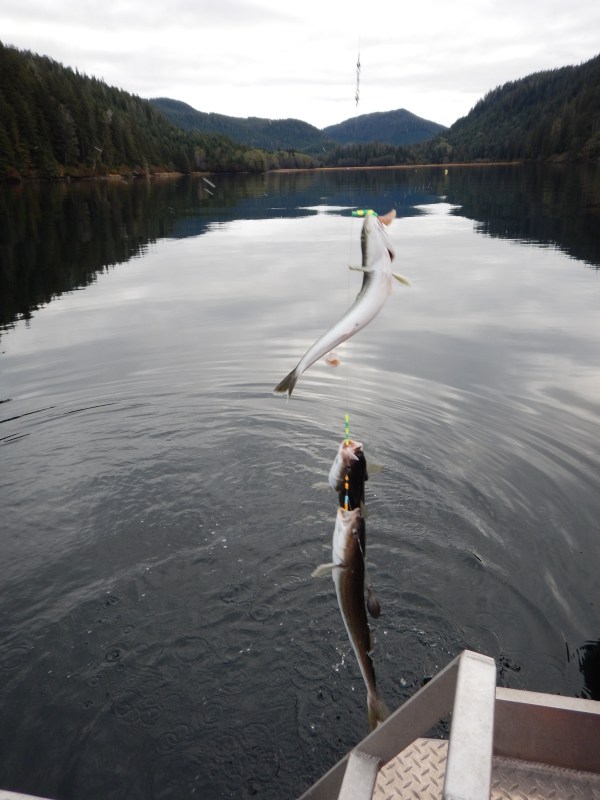
Triple Sablefish_courtesy of CFE Lab

It was so exciting to reel in 3 or 4 sablefish at once! We caught nearly 300 all together.

Joe Krieger, a postdoc and collaborator on the project, was amazed to see the behavior of the fish in the wild. He said,

I’ve been feeding young-of-the-year sablefish in the lab so I had some appreciation for their lustful appetite and piranha-like feeding displays, but that was nothing compared to looking over the boat and seeing a swarm of 20-30 sablefish streaming to the surface in pursuit of my jig. Their voracious appetite and apparent generalist feeding strategy certainly help to explain why these fish are able to grow as quickly as they do.

Justin Priest, a MS student studying Arctic fish ecology, agreed:

The way that the fish were so clustered really surprised me. Fishing 100 feet in either direction yielded almost no fish, but when on top of them, there were a lot down there…how voracious they were really surprised me.

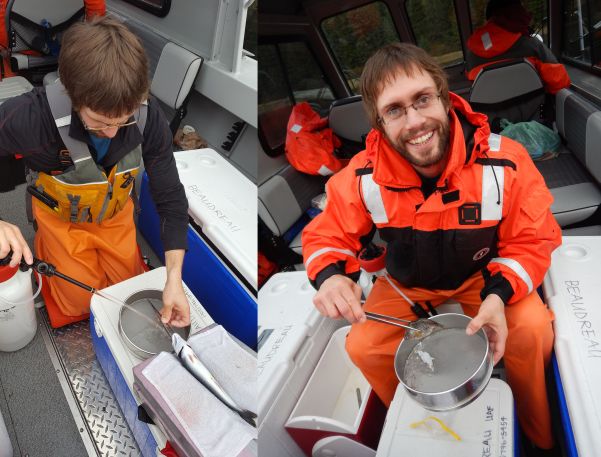
We retrieved the stomach contents of the ravenous sablefish using gastric lavage, a non-lethal technique that involves flushing out the stomach of a sedated fish with a gentle stream of water. I have lavaged thousands of fish, from 30-pound lingcod to baby salmon no longer than my pinky finger. Yet, I am still excited each time to see what ecological clues lie inside the stomach of a fish. Luckily, Matt, who will be doing a lot of gastric lavage over the next couple years, found it fun too:

I learned how to perform gastric lavage, and enjoyed seeing the stomach contents pour into the sieve. It’s like a box of gross fishy chocolates, you never know what you’re going to get.

Matt Lavaging_photos by Justin Priest and CFE Lab

Matt retrieves the stomach contents of a juvenile sablefish using gastric lavage. Have you ever seen someone so happy to be holding a sieve full of fish vomit? Left image by Justin Priest.

As with all fieldwork, there were unexpected challenges. One of our goals was to measure the energy content of the main food types being eaten by sablefish in the fall. Sablefish were primarily consuming juvenile herring, amphipods, euphausiids (krill), and jellies. For most prey groups, we were able to salvage intact, minimally digested prey from the stomachs. As Cheryl Barnes (PhD student) noted, “sablefish eat tiny euphausiids,” so we tried to supplement euphausiid samples from stomach contents with field collections of more intact prey. Our attempts to catch euphausiids using light traps was unsuccessful, but we have some ideas about how to improve the process next time.

Camaraderie and teamwork

Science is fun when you’re working with fun people. And this crew sure was fun! In between the serious work of research – navigating to the study site, catching fish, recording data, keeping fish alive – we did a whole lot of laughing and snacking (see below). Rhea Ehresmann, a MS student studying sablefish movement ecology, said it best:

The most memorable aspect of the fieldwork was getting to know everyone better. Fieldwork provides an opportunity to disconnect from phones and email, and focus on the project together. We were able to spend more time in person working and talking together as a team.

Rhea & Cheryl_courtesy of CFE Lab

Rhea (left) drops her line in the still waters of St. John Baptist Bay, while Cheryl (right) moves a newly captured sablefish to the holding tank.

As far as safety goes, the owner of the boat rental company had set a low bar as he handed us the keys: “Just don’t sink the boat!” I’m happy to say that not only did we not sink the boat, but we got our crew safely to St. John Baptist Bay and back every day. Yes, we got soaked with rain and sleet, but the wind was kind and I saw more rainbows in the span of one week than I thought possible (outside of Hawaii). Joe summed it up perfectly:

Having just moved to Southeast Alaska I am still awed by the natural beauty of the Inside Passage: snow covered mountains, endless forests, sunlight glistening off the ocean surface, sea otters, bears. I could go on and on. We were extremely fortunate to have several excellent days of weather, which really was the cherry on top of an all-around great trip.

We also did a lot more singing than I expected. Wednesday was Alaska Day, and Matt serenaded us with the Alaska state song on the way to the boat. We topped off the week with karaoke and an impromptu dance party at Ernie’s Saloon, in celebration of Joe’s birthday. A sign of a good week in the field indeed.

Happy Team_courtesy of CFE Lab

Joe, Justin, Matt, and Anne (left to right) celebrate the end of a successful trip.


Our favorite field snacks

Joe: Definitely the dark chocolate covered dried mango. I probably ate over half of the bag. Dark chocolate and fruit are healthy right?

Rhea: My go-to favorite field snack is cheddar and caramel popcorn mix. It makes a great snack because it satisfies salty and sweet cravings at once!

Cheryl: duplex cookies 🙂

Justin: Of course Grandma Tillie’s. And I’m not even a sweets guy!

Matt: Grandma Tillie’s blueberry donuts with lemon glaze narrowly edged out her pumpkin rolls. Mmm, so good.

Anne: I gotta agree with Matt and Justin!

In a future post, I will talk more about the research itself and why we think sablefish are so interesting. For now, you can find more information about the sablefish studies on our current research page.

All photos in this post are courtesy of the Coastal Fisheries Ecology Lab unless otherwise noted.