From the beltway to the icefield: An East Coaster’s experience in Juneau

by Willem Klajbor

What does the ideal summer vacation sound like to you? The image that pops into most people’s heads probably resembles an island resort somewhere, fully stocked with colorful drinks, and white sand as far as the eye can see. The average person probably wouldn’t come close to thinking about wading into the frigid ocean at 4 am, wearing a rain jacket every day, or evading bears on a hike. And the average person definitely wouldn’t want to be working in those conditions!

Let me back up – my name is Will, and I was lucky enough to spend last summer as a research intern in the Coastal Fisheries Ecology Lab. My hometown is in suburban western New York and I’m currently a senior at the University of Maryland, College Park, studying Marine and Coastal Management, Economics, and GIS. When I was a sophomore, I received the NOAA Ernest F. Hollings Undergraduate Scholarship, which gave me the opportunity to assist with research on any NOAA-funded project between my junior and senior years. The good news for me was that it led to ten weeks in the 49th state, where rain, cold, and bears are plentiful.
Business casual_photo by Will Klajbor

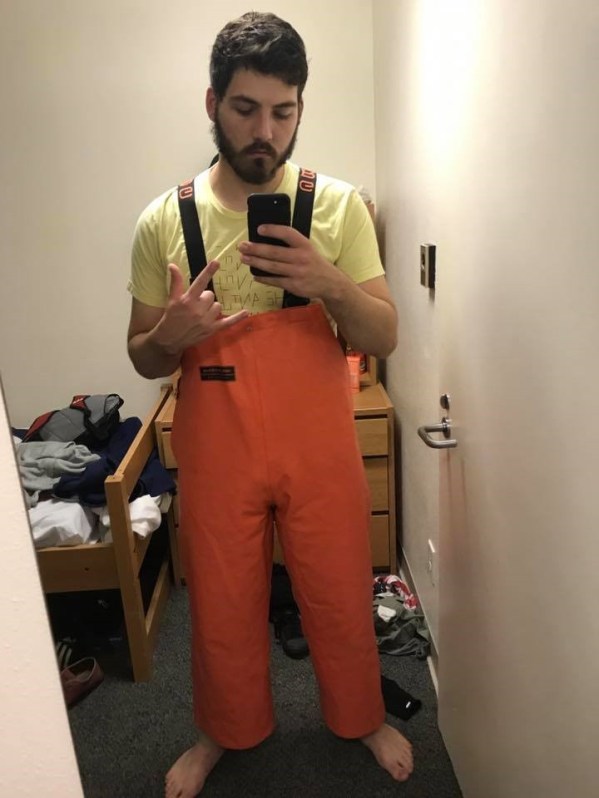
Will models “Juneau business casual.”

Specifically, I was working with Ph.D. candidate Maggie Chan to evaluate subsistence harvesters’ responses to a relatively new set of halibut fishing regulations. There are a lot of different terms for what I was: intern, research assistant, apprentice. But for me, all of that just meant working as a Swiss Army knife for the project – sometimes doing background research, other times managing and organizing our data, and even making maps. This was my first experience doing real research of any kind, so I was nervous going in, but Anne and Maggie made me feel at home right away and always kept me challenged with new tasks.

I also got to do some beach seining with Doug Duncan, another graduate student in the lab. There’s a great blog post about what that’s like here (link), and though there were some very early mornings and some very drowsy afternoons as a result, I was grateful that I had the opportunity to get in the water and do some field work while I was up north.

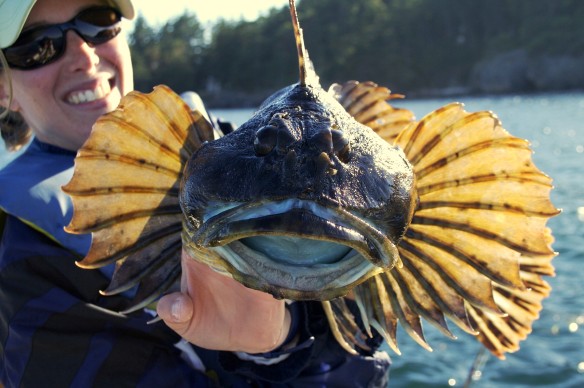
Starry flounder_photo by Phallon Tullis-Joyce

Sharing a moment with a starry flounder. Photo by Phallon Tullis-Joyce.

I was also lucky enough to be living with a group of other interns from around the country who were in Juneau working on projects at UAF. On top of that, we all grew close to the graduate students we were working with, so there was no shortage of people to show us new things about Juneau. And don’t get me started about Juneau – the city really is a hidden gem. Nearly every minute of my free time in Alaska was spent outside trying to find another hidden bike path or spot another bear. If you’re into leg workouts, I can tell you that I got a chance to hike some of the major day trails around the city, and those were usually enough to put us on our butts for the 12 hours that followed. But the view from the top was always worth it.
CFE Lab camping_photo by Maggie Chan

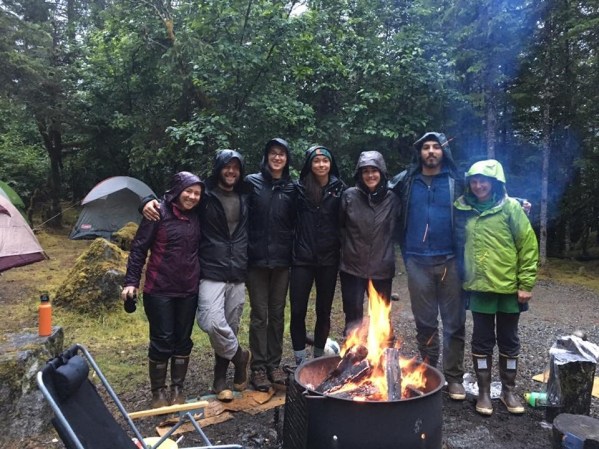
Building a fire in the pouring rain is one of the important life skills you learn in Southeast Alaska. Coastal Fisheries Ecology Lab members, pictured from left: Cheryl, Doug, Aiden, Phallon, Madison, Will, and Nina. Photo by Maggie Chan.

My uncle, who’s a commercial fisherman in Homer, Alaska, warned me before I left that a lot of people catch “Alaska Fever” when they visit. And honestly, I really did think he was exaggerating. Now, I’m back in College Park, and it’s often difficult to go more than a couple of hours without daydreaming about the mountains or the whales that liked to hang out just outside the lab. Even though it rained nearly every day I was there (I’m not exaggerating, I could count the sunny days on one hand) and it never really got above 65°F, Juneau really left its mark on me. I really do love it here in Maryland too, but I can’t ignore the symptoms – I went up north and caught the bug, and now I’m stuck with “Alaska Fever.” Check it out for yourself and you’ll see what I mean.

Glacier view_photo by Dana Flerchinger

On rare sunny days, Juneau spoils you with amazing views of mountains, glaciers, and the sea. Photo by Dana Flerchinger.

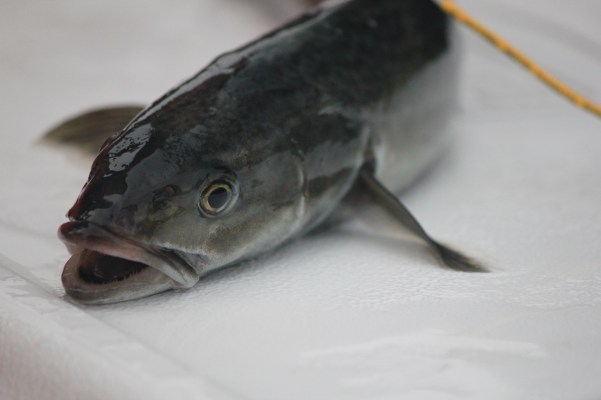
Fishing for science—A landlubber’s journal

by Matt Callahan

I recently had the opportunity to participate in the final leg of NOAA’s sablefish stock assessment longline survey. I’m starting a Master’s program focused on juvenile sablefish, so taking part in this survey and observing some of the ins and outs of longlining will provide a valuable perspective as I conduct my research. That said, thriving at sea was an adjustment that this landlubber never quite made.

Before boarding the plane to Kodiak, I bought a jump rope at Second Wind Sports so I could keep training for the Klondike road relay on the boat. It turned out to be a kid’s jump rope and since I’m well over four feet tall it didn’t work. “That’s ok,” I thought, “there will be plenty of line on a longliner to make my own jump rope.” This turned out to be a lost cause. Between queasiness and boat rocking that was incompatible with jumping I never got a chance. Fortunately, the Klondike is as much about fun, cheering, and sleep deprivation as running fast.

Sunset_photo by Matt Callahan
“Just think, you could be selling insurance in Detroit for a living, Matt.” –Captain Sam. Photo by Matt Callahan.

Our vessel was a 150-foot longliner, the Ocean Prowler. Captain Sam was a soft spoken, kind, confidence-inspiring seaman who always had a smile on his face. The chief engineer, Frank, counterbalanced Sam’s sometimes reserved manner with a story or opinion for every occasion. Josh joined the crew last minute as the cook and impressed all of us with high-end, restaurant quality food. He can also cut apples so they look like swans, or possibly albatross. The rest of the crew were either deckhands who operated the longlining gear or processors who packaged fish after it was brought on board. There were four biologists on board: chief scientist Karson, Sabrina, Denis, and me.

Juvenile sablefish_photo by Kari Fenske

A juvenile sablefish that was tagged on a different survey near Sitka, Alaska. Photo by Kari Fenske.

The survey samples the same stations annually throughout the Gulf of Alaska over the course of the summer. At each station, we set two lines and a set is divided into 80 skates (lengths of groundline) with 45 circle hooks, each separated by a cannonball weight. We counted and identified every fish caught. Sabrina or Denis stood in a phone booth-sized box on the upper deck, above the roller that pulls in the line, with tablets to record their observations. Whoever was not on deck duty noted the sex of the sablefish and measured all fish with a fancy electronic fish measuring board. Karson and I collected otoliths, which are bones in a fish’s head with annual growth rings that indicate its age. The sablefish otoliths were sent to Seattle for analysis after the survey. (Dear analyst: We tried to clean off the otolith vials and boxes well, but if they’re still foul with fish gore, I’m really sorry!) We also tagged and released some of the sablefish. The deckhand would flick each fish off its hook into a net and we would insert a small numbered tag into its back muscle then release it. Rewards are offered for recaptured fish and the data allows us to track sablefish movement and growth.

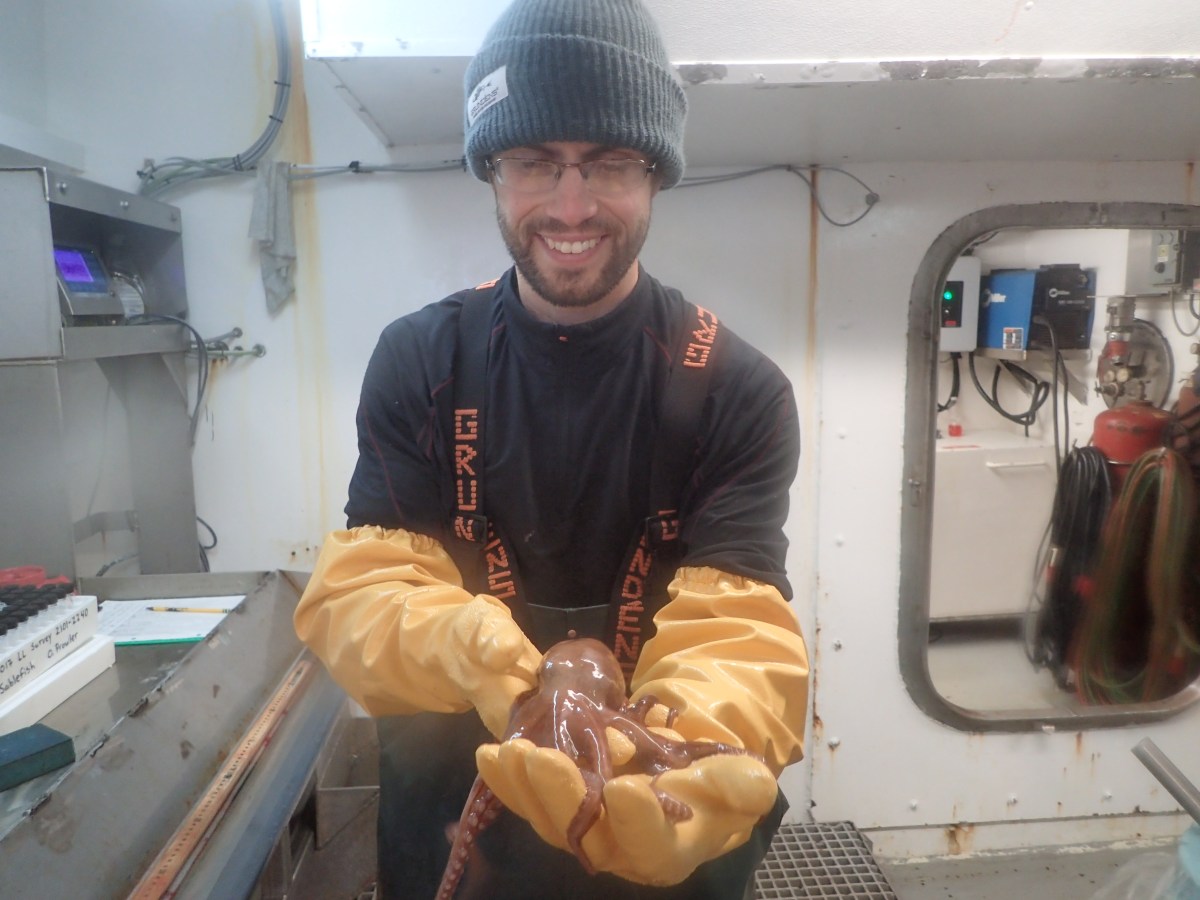
Baby octopus_photo by Karson Coutre.JPG

A baby Pacific octopus (later released alive) and me. Photo by Karson Coutré.

Our most exciting catches were two sleeper sharks on shallow, gully stations. These massive predators thrashed around on the bottom and created horrible tangles in the lines. We also caught a lot of giant grenadier, which dominate biomass at the deeper end of the sablefish habitat. Apparently, considerable effort to try to do something useful with their meat has been fruitless.

Seas up to twelve feet tossed us around for much of the leg. I started off taking the king of seasickness medication—the coastguard cocktail. It’s supposed to prevent nausea while keeping you alert, but I still felt like a tired, duller version of myself and slept eleven hours each night at first. I never got violently seasick but never felt fully well either.

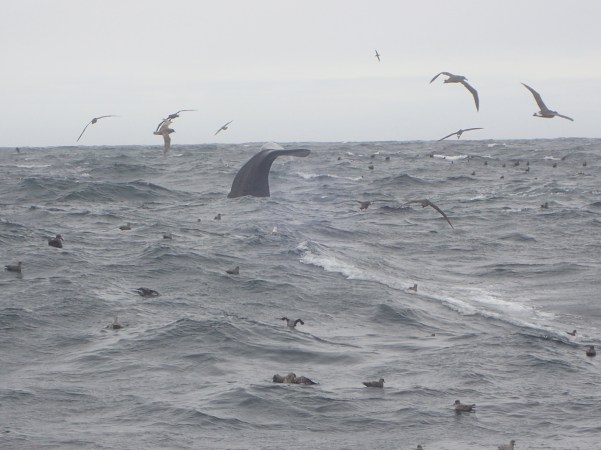
Despite the internal malaise, I enjoyed many aspects of the trip. We saw spectacular sunsets, though the weather would often return to gloom by day. Sperm whales swam close to our boat before diving to pluck fish off the longline. These huge, weird, ocean monsters are known to steal commercially caught fish from longlines in an act called “depredation.”

Sperm whale_photo by Karson Coutre.JPG

Time for lunch! Photo by Karson Coutré.

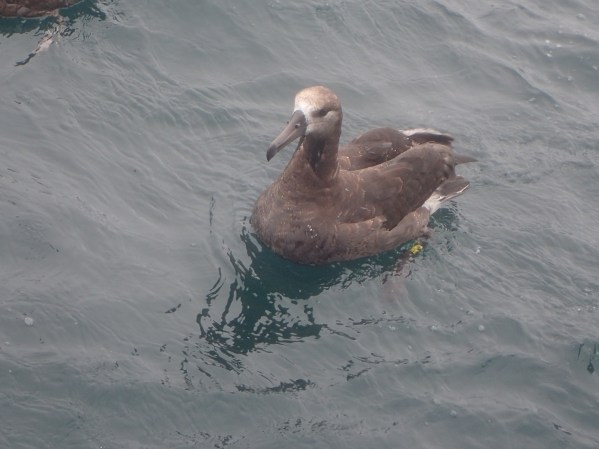
We saw albatross and several other offshore birds. Sabrina is a major bird enthusiast and helped me learn to identify them all. She has a powerful camera and got good pictures of brown and masked boobies, which are among the few confirmed sightings in Alaska of those species. Unfortunately, I missed them but still got to share in her excitement. Thick clouds denied us a view of the much anticipated solar eclipse and made for a very anticlimactic dramatic countdown. It only would have been a partial eclipse up here anyway and apparently no one could see it in Juneau either.

Albatross_photo by Matt Callahan.JPG

Some of the Albatross have identification bands on their legs. Sabrina, one of the biologists, took pictures of the numbers when possible. Photo by Matt Callahan.

After two weeks at sea we finally pulled into Dutch Harbor. The crew were grateful for the amenities of shore. Some of them would go home to see their families, others would re-embark on the Ocean Prowler in a couple of days to fish for Pacific cod (“P-cod”). Karson wished the trip lasted longer—she feels most alive at sea and fieldwork is a major highlight of her job. When I stepped off the boat and felt the ground unmoving under my feet, an irrepressible grin took over my face. I hadn’t transformed into a salty mariner, but I’m still glad I went.

To learn more about what it’s like out on the longline survey, please check out this video made by former fisheries student and first rate human being Phil Ganz: https://vimeo.com/144235708.

Read more about the sablefish research being done by the Coastal Fisheries Ecology Lab, including current graduate students Matt and Rhea and alumna Karson, on our current projects page.

Why I love sculpins (and why you should too)

by Anne Beaudreau

Sculpins get a bad rap. Scorned by anglers and scoffed at by scientists, these bottom-dwellers have a host of unflattering nicknames, from “bullheads” to “double uglies.” The array of adjectives used to describe them is reliably disparaging: ugly, useless, homely, drab, and a nuisance.

All that trash talk is pretty unfair, if you ask me. Sculpins are not only a fascinating group of abundant, ubiquitous fishes but they may very well be the silent rulers of coastal marine ecosystems. To show you why, I bring you three vignettes about the wonderful world of sculpins.

The red Irish lord is a real beauty.

One. A Thing of Beauty

Sculpins come in all shapes, sizes, and colors. They have lovely and bizarre names, like Myoxocephalus polyacanthocephalus, the scientific name for great sculpin that roughly translates to “muscle-head spiny-head.” Most have spines protruding from their cheeks—shaped like antlers, spikes, combs, and clubs—to protect them from the mouths of predators. They need that protection because, truth be told, most sculpins are less than a foot long. But a few can give anglers a run for their money. The biggest sculpin – the cabezon – can reach sizes of 3 feet and 30 pounds1. I have heard stories of aggressive cabezon head-butting divers who came too close to the egg masses they were guarding. Some sculpins are quite beautiful and lavishly decorated with colorful designs, like the red Irish lord, and others are adorable squat little creatures, like the buffalo sculpin. Sculpins have been inspiration for both art and beer.

Ragga with baby sculpin_photo by Emily Whitney.JPG
Ragga shows off an adorable baby sculpin that was caught in a beach seine near Juneau, Alaska. Photo by Emily Whitney.
Cabezon_photo by Aaron Dufault.jpg

Cabezon were fun to catch in the San Juan Islands, Washington. They put up a fight and are tasty too. Photo by Aaron Dufault.

Crested sculpin_photo by Anne Beaudreau.JPG

Just this week we were fortunate to see this beauty, a crested sculpin that was hanging out in some algae growth on a crab pot line. Photo by Anne Beaudreau.

Sculpin leggings_photo by Anne Beaudreau.jpg

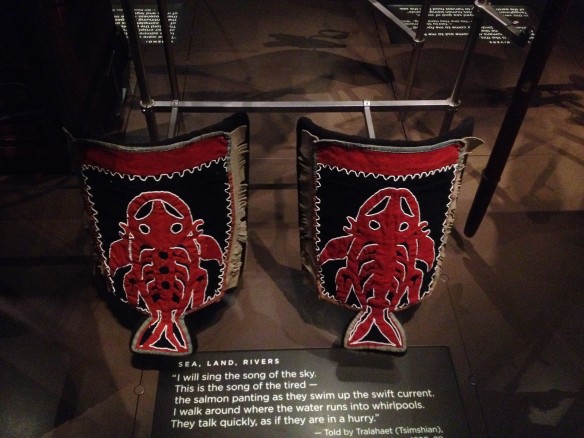
I spotted these beautiful Tsimshian dance leggings adorned with sculpins at the Anchorage Museum.

Two. Eat or Be Eaten

Wherever they live, sculpins are leading actors in an ecological drama that unfolds every day, where all creatures must eat or be eaten. They play a central role in nearshore ecosystems as both prey and predators. In my graduate research, I found that sculpins were one of the most common diet items for lingcod, a large toothy predator living in kelp forests of the North Pacific. Some small sculpin species serve another important role for lingcod—they act as cleaners, picking off parasites from inside the open mouth of the lingcod itself! It is a dangerous job and one that sometimes lands the helpful sculpin at the bottom of a predator’s stomach.

Buffalo sculpin_photo by Aaron Dufault.jpg
Buffalo sculpins make up for their small stature with intimidating spines that deter predators. Photo by Aaron Dufault.

Sculpins may make a tasty snack for larger creatures, including people, but they are also terrific predators in their own right. Most sculpins are basically a big mouth with a tail attached. One of the species we’ve been studying, Pacific staghorn sculpin, is armed with antler-like spines on either side of its face and can eat other fish that are half of its own length. Can you imagine swallowing a 2- to 3-foot long animal alive and whole? What a beast! Staghorn sculpins are omnivores, feasting on everything from baby mussels the size of a poppy seed to carcasses of spawning adult salmon. Just like toddlers, staghorn sculpins can be picky eaters too, sometimes chomping only the siphons off the tops of unsuspecting clams. Some staghorn sculpins even have an expensive taste for caviar: we once collected a staghorn sculpin that had gorged itself on 85 salmon eggs!

Stag eating fish_photo by Emily Whitney.JPG
There is no creature so bold as a hungry sculpin. Photo by Emily Whitney.
StaghornHotdogs_Anne Beaudreau.jpg

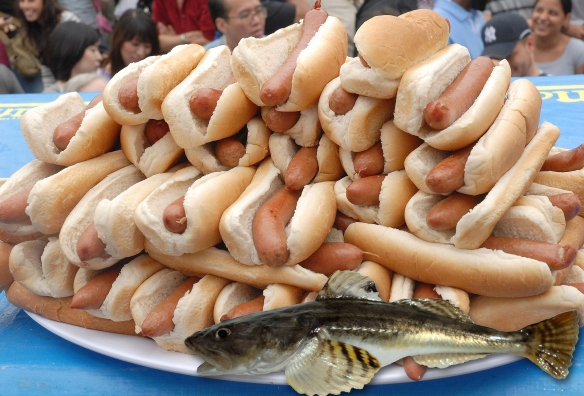
If you’ve ever wondered which intertidal species would win a hotdog eating contest, look no further—it’s the staghorn sculpin.

Three. Abundant and Adaptable

Sculpins are everywhere. They are found throughout the world, in both freshwater and saltwater. There are over 750 species of sculpin and around 300 species in the family Cottidae alone2, which is the group of sculpins that I know best. Here in Juneau, sculpins dominate fish communities in the nearshore. About 40% of the fish we catch beach seining near river deltas are none other than the Pacific staghorn sculpin. Many sculpins live in harsh, dynamic environments like the intertidal. Tidepool sculpins, tiny creatures no longer than your finger, have a strong urge to stay close to home. Some have been observed in a single tidepool for more than a year3. If they are moved from their home pool, these wee sculpins can find their way back, even after being on an extended vacation (i.e., moved to an “unnatural environment” by scientists for 6 months)3. As for staghorn sculpins, there is so much we still don’t know about where they live, how far they move, or how many of them are out there, chowing down on a smorgasbord of salty snacks. Staghorns live in the sea, but can withstand freshwater and can even breath air to some extent4. Given the challenging environment they navigate every day, perhaps sculpins just might be the most equipped of all to deal with our rapidly changing oceans.

While I may not have convinced you that sculpins are at least as cool as salmon, I hope that you have gained a little more appreciation for them. If nothing else, show those bullheads a little respect. They might take over the world someday, in all their air-breathing, spine-wielding glory. Don’t say I didn’t warn you.

Big bullhead_photo courtesy of CFE Lab.JPG
Behold, the glorious Pacific staghorn sculpin. Photo by Doug Duncan.

Bonus sculpin fact: Some sculpins can change the shape of their skulls to fit through tiny spaces! Ellen Marsden of the University of Vermont told the story of how she and a student made this amazing discovery: https://www.uvm.edu/uvmnews/news/faculty-feature-ellen-marsden

Froese, R., and D. Pauly, eds. 2017. Scorpaenichthys marmoratus in FishBase. www.fishbase.org. Accessed September 2017.

Mecklenburg, C.W., T.A. Mecklenburg, and L.K. Thorsteinson. 2002. Fishes of Alaska. Am. Fish. Soc., Bethesda, MD.

Green, J.M. 1971. High tide movements and homing behaviour of the tidepool sculpin Oligocottus maculosus. Journal of the Fisheries Research Board of Canada 28(3): 383-389.

Love, M. 1996. Probably More Than You Want to Know About the Fishes of the Pacific Coast. Really Big Press, Santa Barbara, California.