Three weeks at sea: Life aboard a catcher-processor

by Cheryl Barnes

As a PhD student, I spend a lot of time at the computer, analyzing data on fish predators and their prey in the Gulf of Alaska. The decades of data on fish abundance and diets collected by Alaska Fisheries Science Center, one of NOAA’s research labs, is a wealth of information. For my research, the data are a window into understanding the impacts of predation on walleye pollock, which support the largest single species fishery in the world.

Because it’s generally considered good practice to get out of the office and experience the data collection process, I decided to volunteer for this year’s groundfish survey. The entire Gulf of Alaska bottom trawl survey takes place between May and August every other year and stretches from the U.S.-Canada border in Southeast Alaska to the Aleutians. This summer, I participated in the fourth and final leg of the cruise, which lasted three weeks and ranged from Seward to Ketchikan.

Being slightly claustrophobic and having only experienced day trips at sea, I was a bit concerned about how I might fare on this particular excursion. Whatever happened though, it was going to be quite the learning experience! I was pleasantly surprised when we pulled up to the dock and I set eyes on what would be my home for the next 19 days. The F/V Ocean Explorer was an incredibly spacious 155-foot catcher-processor vessel with lots of room to move about.

image001

F/V Ocean Explorer at the dock in Seward, AK
Photo Credit: Cheryl Barnes

As you might expect, this commercial pollock fishing boat was equipped with a considerably large and open-style trawl alley necessary to accommodate vast amounts of net mesh, bulbous floats, and heavy lead. The deck also provided ample space to sort, weigh, and measure fish after each haul had been brought in. The factory (usually used to process and freeze the catch) was located below deck, but because the vessel was chartered exclusively for scientific purposes, fish were not kept or sold. Instead, we used the area as prep space and dry storage.

image002

Trawl alley and upper deck on the F/V Ocean Explorer
Photo Credit: Cheryl Barnes

On continuing to explore my floating residence, I found a hallway with sizeable staterooms just below the wheelhouse. I’d heard horror stories of five people being packed into a single room where only one of them could get out of their rack at a time. As luck would have it, we were afforded two-person units with roomy bunks, plenty of storage, and enough space to stand…two at a time. Conveniently, I also ended up with the only other woman onboard as my roommate, who happened to be one of the nicest and most considerate people I’ve ever met.

After our tour of the galley and a series of safety drills, I met each of the crewmembers onboard. Immediately, I could tell that our captain was one of the good ones. He was really outgoing, super approachable, and quite the storyteller! During the three-week voyage, I constantly found myself up in the wheelhouse, listening to tall tales and peculiar superstitions at sea. Our captain also wrote the funniest things in his communications to the first mate, which I checked on a daily basis just for a good laugh (sorry, I was sworn to secrecy). In addition to entertainment in the wheelhouse, we could always count on a good joke—typically of the dirty variety—from our first mate. The crew was always excited for a new batch of scientists because the rotation meant that they could retell stories and land their favorite punch line for the umpteenth time. We (the slightly nerdier bunch) loved it because even when we were all working like dogs, the crew helped keep things light and lively. All in all, I’d say that I couldn’t have been stuck on board with a better group of people.

It was a pretty cool experience seeing what a large commercial fishing vessel looks like, both inside and out. Mostly though, I enjoyed the opportunity to identify a wide variety of Alaskan groundfish species. Some of these fish looked familiar from the years I had spent working in fisheries in California, but others I had never even heard of or had only seen in books.

Species caught on different tows. Some hauls consisted of a wide range of species (left) while others were much less diverse (right). Photo Credit: Nancy Roberson

Among my favorite items found on the sorting table were the invertebrates. With deepwater tows, we got to see some pretty gnarly looking sponges, molluscs that look like hot dogs (one is actually called the “sandy hot dog” because it quite literally looks like you dropped an uncooked hot dog in the sand), and the sea mouse, a polychaete worm that I once used as inspiration for a very geeky Halloween costume. We also caught some sad-looking flatfish that we morbidly decided to collect eye parasites from.

Cool finds: some of the more interesting and rarely captured trawl specimens (left: sponge, right: juvenile arrowtooth flounder with eye parasites). Photo Credit: Cheryl Barnes

But it wasn’t always rainbows and roses. Occasionally, we’d get really “lucky” and bring up a net completely full of super sticky mud that we’d have to struggle through to find its biological inhabitants. One such tow took us four and a half hours to get through. Because we worked well past lunch, it made for a lot of very hangry scientists.
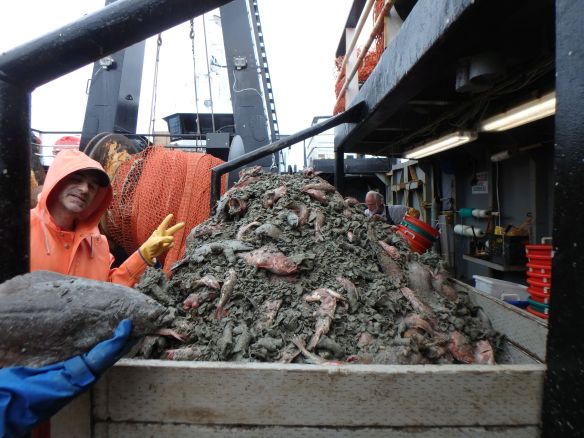
OLYMPUS DIGITAL CAMERA

One of three net dumps on the sorting table resulting from a “mud tow”
Photo Credit: Cheryl Barnes

Of the more feel-good moments was when I could immediately release live fish from the haul. This, I loved, probably because I’ve spent so much time using catch and release survey methods. Rockfishes experience barotrauma, where the air in their swim bladder expands as they are brought through the water column, making it difficult for them to swim back to depth after processing. Like flatfishes, it is also difficult to identify their sex without cutting them open to get a good look at their internal organs. However, lingcod and spiny dogfish come up in relatively good condition and their sex can be easily determined from the outside (yes, we love checking out fish junk). This made is possible to quickly collect the data we needed and let them go alive. And even though this meant getting the occasional tail slap to the face, it was well worth it to watch them swim away after we were done with them.

OLYMPUS DIGITAL CAMERA

Cheryl Barnes posing with a big lady lingcod just before processing and release
Photo Credit: Nancy Roberson

Though we mostly enjoyed processing fish day in and day out, everyone was pretty stoked when we pulled up the last tow of the survey. It signified our imminent ability to step foot on land, grab a cold beer, and sleep in our own beds. Even without the constant rocking of the boat that lulled me to sleep every night during the survey, I was ready to spread out again, return to my own space, and close my eyes without hearing the ever-present clanking and engine noise.

OLYMPUS DIGITAL CAMERA

Science crew celebrating our final tow of the survey
Photo Credit: Nancy Roberson

It’s been two weeks since I got home and I definitely miss the sunshine out on the open ocean. It’s been an exceptionally rainy summer here in Juneau and I am no longer able to simply climb to the upper deck when I want to bask in the glory of blue skies and calm water. I also miss chatting with our gregarious captain and crew, though I hope to stay in touch. And instead of flinging fish, listening to wise crack after wise crack, selecting from unreasonably diverse ice cream flavors, and passing by magically refilled bowls of bite-sized chocolates in the galley, I’ll be staring at a computer screen, reading scientific papers, and writing code for the rest of my days (or the next two years…it’s yet to be determined).

image010

Sunset captured from the F/V Ocean Explorer in Ketchikan, AK.
Photo Credit: Cheryl Barnes

Read more about Cheryl’s research on our current projects page. For more information about NOAA’s research program in Alaska, visit the Resource Assessment and Conservation Engineering Division (RACE) and Resource Ecology and Ecosystem Modeling Division (REEM) online.

The 7-Minute Workout: Beach Seining Edition

by Anne Beaudreau

A few years ago, I learned about a too-good-to-be-true workout plan that is scientifically proven to do as much for your body in 7 minutes as several hours of running or biking. The so-called 7-Minute Workout is high-intensity interval training, involving 12 exercises that are done for 30 seconds each with 10 second breaks in between. According to the experts, you need to “hover at about an 8 on a discomfort scale of 1 to 10”1 to make it really effective.

That sounds pretty good, but don’t you think there’s a more enjoyable way to get a full-body workout? I’m here to tell you that there is, and it’s called beach seining in the intertidal. On 4-8 days each month during spring and summer, Master’s student Doug Duncan and his crew (sometimes including me) get up at the crack of dawn, load up the truck, launch the skiff, and venture out to estuary sites along the Juneau road system to catch fish. We didn’t want to keep our great workout plan a secret, so here’s the scoop. There are only 8 exercises, because that is all you need to hit 8 on the discomfort scale!

Exercise 1. Wader donning (really, doing anything in waders)

Once we arrive at the boat launch, the workout begins with a careful balancing act: donning the waders. This doesn’t necessarily take exertion, but it does require some balance and coordination, which may be hard to come by at 4 in the morning. The waders add a nice resistance to the rest of the day’s activities.

Pregnant in waders_photo by Emily Whitney

The author in the field at 5 months pregnant. If you think bending down in waders is hard normally, try doing it with a bowling ball for a belly.


Exercise 2. Bucket wrangling

Beach seining involves a lot of bucket maneuvering: hauling heavy buckets of water to the beach, returning buckets of water and fish to the boat. On a bad weather day, when it’s too windy to use the skiff and we need to carry full buckets down long stretches of beach, bucket wrangling takes on a whole new level of intensity. You will discover muscles in your wrists and forearms you never knew you had.

Exercise 3. Zombie walk

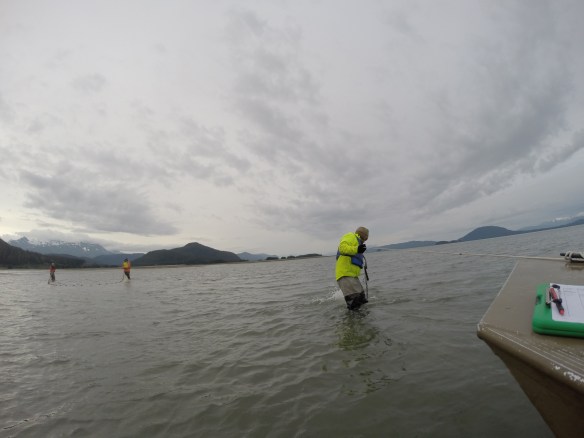
This is the bread and butter of the beach seining workout. First, loop the end of the leadline around your wader boot. Next, start walking the net through the water, keeping a nice steady rhythm. As you walk, drag your foot along the bottom to keep the leadline down and the fish in the net. This gives you both the appearance of a zombie and a wicked inner thigh workout. Can you feel the burn? Be sure to alternate your seining leg to work both sides.

Emily zombie walk_photo by Anne Beaudreau.JPG

Emily demonstrates perfect “zombie walk” form.

Exercise 4. Algae resistance

This is full body resistance training, algae-style. When conditions are right, the intertidal is green with ulva. The thin, green sheets of “sea lettuce” clump together and aggregate in the center of the net, making it heavier and heavier as you drag it to shore. Target muscle groups include: everything from your neck down.

Remember, you are doing all of this in stiff, completely non-breathable waders (see Exercise 1). On a rare sunny day, this makes for a somewhat stifling endeavor. If you want to increase the intensity of any exercise, add in a quick jog up the beach to scare ravens away from the buckets of fish.

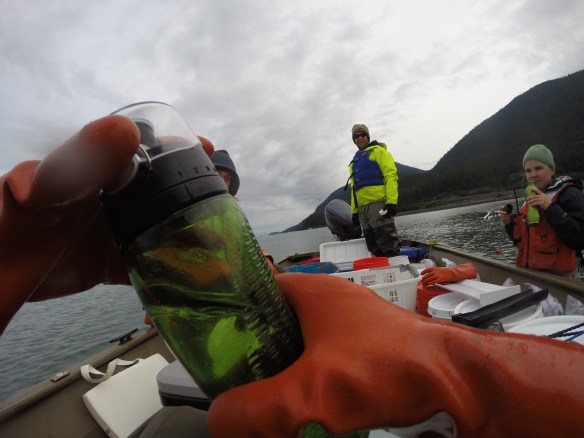
DCIM104GOPRO

Always remember to hydrate.

Exercise 5. Bucket lift

Have you ever tried lifting a 5-gallon bucket full of seawater and fish above your chest and up over the side of a skiff without spilling? It’s harder than you think. This is best done as a group: one, two, three, buckets up!

BucketsUp

Exercise 6: Bucket pull

This exercise creeps up on you suddenly. Let me set the scene for you. Two people are pulling the net onto the beach and you can see that it’s a big haul of fish. You’re going to need a lot more buckets. Quick, let’s pull these two apart and fill them with water! But the already-wet buckets have decided to adhere to each other like superglue. Hence, a vigorous attempt at bucket separation ensues, as shown below. This is one challenge you can’t face alone!

DCIM104GOPRO

DCIM104GOPRO

Doug and Emily exert themselves during the bucket pull.

Exercise 6. Bug swat

You didn’t think we were going to enjoy this beautiful day without a slew of no-see-ums to keep us company, did you? Better start swatting! The more vigorously you do it, the closer you’ll get to your VO2 max.

Exercise 7. Boat pull

The boat pull is a rather elegant exercise, involving – you guessed it – manually towing a boat full of muddy sampling gear, soggy nets, and buckets brimming with water and sea life. The goal is to keep within throwing distance of the seiners, so that you can quickly anchor up and bring them buckets and measuring boards as they begin to haul in the fish. It gets tough when the wind and currents try to fight your progress.

DCIM104GOPRO

Doug makes the boat pull look easy.

Exercise 8. Quicksand hop

We have learned the hard way that the only way to traverse river delta quicksand is quickly and decisively. So, pick up those hefty wader boots and hop, hop, hop back to the safety of the water! Incentive for not stopping is that you won’t lose your boots to the mud of the Mendenhall River estuary. Simple as that.

Congratulations! You have completed the beach seining workout in a mere 3 hours. Wasn’t it fun to huff and puff among beautiful glacier views, nets teeming with the next generation of salmon, and the company of good fisher folk?

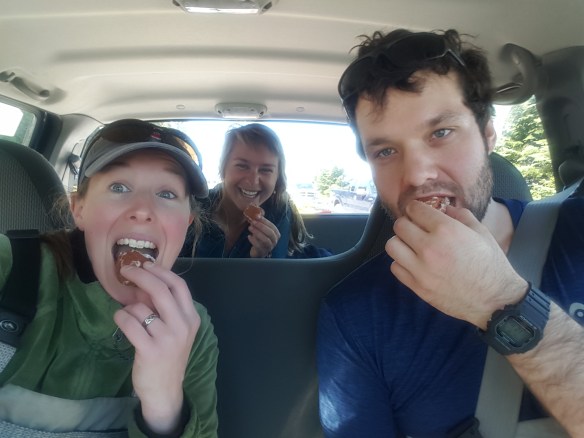
Eating donuts_photo by Anne Beaudreau

On the ride back to campus, all that hard work is quickly negated with a post-seining donut from Breeze-In, courtesy of our fearless leader Doug. But, at least we got our heart rates up while experiencing another beautiful morning in Juneau.


If you’d like to learn more about the science itself, please visit our current research page and scroll down to the projects titled “Navigating the predator gauntlet: Impacts of nearshore marine fishes on hatchery and wild juvenile salmon in Southeast Alaska” and “Tracking energy flow to fishes in glacially-influenced estuaries of Southeast Alaska.”

1Reynolds, Gretchen. 9 May 2013. The Scientific 7-Minute Workout. NY Times. https://well.blogs.nytimes.com/2013/05/09/the-scientific-7-minute-workout/

Film, Fish, and Family: A Conversation with Composer Lou John B

by Anne Beaudreau

This past spring, my collaborators and I created a short film called Knowing Fish that celebrates the importance of fishing in Alaska’s coastal communities and the value of fishermen’s knowledge for science and management. The film also highlights the research our team has been doing to document ecological knowledge of recreational and subsistence fishers and use it in combination with scientific knowledge to better understand long-term change in coastal ecosystems.

There were many wonderful aspects of working on the project, but among the highlights for me was having the opportunity to collaborate with my brother Lou, an LA-based musician who composed the music for the film. I sat down with him recently to talk about his work in music and film and get his take on the experience of writing a score to a story about Alaskan fisheries.

♦♦♦

ANNE BEAUDREAU: Tell me about your experience in music and film.

LOU JOHN B: I’ve been playing music since I was around six. The first instrument that I really gravitated towards was classical guitar. I didn’t get into electric until middle school, where I more or less taught myself blues, rock, and jazz. Post high school, I went to Berklee College of Music in Boston, where I took a few film scoring classes and learned about composition. College was when I really started getting into film. I wanted to learn everything about it, and I made it my goal to see as many films as I could. I probably watched On the Waterfront and Cool Hand Luke the most during those years.

ANNE: What is your favorite film score?

LOU: It’s probably Taxi Driver. It was the first score that made me pay close attention to what the music was doing in the film. The composer, Bernard Herrmann, did something to Scorsese’s masterpiece that didn’t seem possible. He made a perfect film even better. Unfortunately, Herrmann died before the film was even released. It was his last score. There are only a few cues in Taxi Driver repeated throughout the film, but they are dark, beautifully low-voiced, and very memorable.

ANNE: In terms of professional music, how you would describe what you’ve done since college?

LOU: Almost a full year after I left college, I moved out to LA to play guitar in the band Shaimus. That lasted about two years. There’s so much I did in Shaimus that I never thought I’d get to do, like touring and making a record in a professional studio. After the band ended, I started writing music for commercials, which is my main gig these days.

ANNE: Have you done any other film scoring before Knowing Fish?

LOU: The first project I worked on was for a short film a friend of mine did, called Animal Fiction. About six months after he released that, he shot a promotional video for a charity in Los Angeles called The Giving Keys, which I scored. That one was interesting because it was set up like a video triptych, consisting of really beautiful shots of LA without dialogue.

ANNE: For Knowing Fish, what was your process for scoring?

LOU: I think I watched it four or five times before you and I talked on the phone. I chose not to think about music the first couple times I watched it because I wanted to know what the film was really about and what it was saying. I knew that the film had a specific purpose, so I made it my goal to pay close attention to that before considering what the music would sound like. Then I soaked up moods from scenery, characters, and colors and started formulating what I thought would be appropriate music for the picture. Visually, almost everything in the movie could have so easily been accompanied by acoustic instruments, so I figured, let’s not do that. I decided to go all electric.

ANNE: It seems like you made a choice to not use acoustic instruments, but to make them sound acoustic, to still give it that feel. In some of those moments, it feels like it could have been somebody strumming a guitar at a campfire…

LOU: …with a big amp in a cave…

ANNE: …yeah, but it still evokes that feeling of organic-ness.

LOU: Well, that’s what I thought was interesting about the film – the juxtaposition of old wisdom and new thought. Perhaps the reason I wanted to go full electric, and not do what was expected, was to bring out those ideas. Old wisdom and new thought aren’t in opposition. As a viewer, you’re happily surprised at the outcome of the film because perhaps you didn’t necessarily expect how hopeful and cooperative the message would be. In a way, that’s what I was thinking when I wrote the music. I knew I didn’t want to do what you’d expect with the music because the film didn’t really do what I expected. I liked the idea of using electric, but still creating that acoustical hominess. It’s like looking at something old through a new lens.

ANNE: The feeling you put on the music was more modern, and I suppose the message that I put on the film was more hopeful than you typically hear when you’re hearing about environmental issues. Musically speaking, were there any parts of the film that were especially easy to write to or especially inspiring?

LOU: The end took the least amount of time to write because of Daniel. What he says brings it down to a real, personal, but also universally relatable level. For that reason, I wanted a lone, washed out guitar leading into the tune at the end. He’s talking about being out there on the open ocean every day, and he says something to the effect of, “I’m not a religious man, but this is like my religion.” I liked the idea of the single guitar there. That’s the nice thing about guitar – you can make something sound important and big if you have the find the right tone and manipulate the sound enough.

ANNE: Can you tell me more about how you mixed the sound?

LOU: I had four tracks to mix: the music, the narration, the interviews, and the B roll sound. I pretty much treated the full sound mix like I do mixing music, making sure each element comes through enough to be heard or felt. It was just as important to choose when to ride up the volume of the score as it was to let the music sit on the bottom of the mix. I spent lots of time making little adjustments to make sure the more dramatic moments were dramatic and the more subdued moments were subdued, sonically.

ANNE: So, what does music do for a story?

LOU: It can completely change the way a story is emotionally or intellectually interpreted by the viewer. It can elevate any situation, driving you to tears or to laugh or to feel afraid. And there are maybe infinite ways to do this, musically. For this film, I tried to use music as a supplemental enhancement to the picture. Certain moments in a film can be just that much weightier if you support them with even the slightest of simple tones.

ANNE: Given that you’re not a scientist and you don’t think about fisheries that much, what did you learn from the film?

LOU: I think the main thing I learned was basically the main point of the film: science and culture can be married pretty easily, philosophically. I kind of feel stupid for realizing that now. As much as I admire science and look to science for the hope of the future, there still seems to be a disconnect in my brain between the world of science and the real daily grind. I don’t know why that is exactly.

ANNE: I don’t think that’s stupid at all. Even though science touches everything in our lives, there’s sometimes an idea perpetuated that science is out of reach unless you’re an expert. Speaking to what you’re staying about science meeting the real world, in ecology and in fisheries, science is about observing the natural world and that’s basically what fishermen do every day. Even though they don’t document that knowledge in the same way that scientists do, these two different processes of developing knowledge can come to the same place ultimately.

LOU: That’s right, and that actually reminds me of another thing I learned from the film. You have two different schools of thought – there’s an analytical side, and there’s a practical side. Both see that things are changing through different lenses, but there’s not necessarily a discrepancy between the two points of view.

ANNE: What connection do you have with fishing and the marine environment?

LOU: I grew up fishing. Dad took us fishing. When I was somewhere between 7 and 10 years old, we fished off Barrington Beach in Rhode Island, and I caught a bluefish. It’s still the biggest fish I’ve ever caught. I struggled with it for almost an hour and a half. My whole body was on fire. There was a point when a gathering started to form, and every time Dad started to help, there was this guy who said “Let ‘im do it, let ‘im do it!”

ANNE: Would you ever want to collaborate again on something?

LOU: Absolutely.

To learn more about Lou John B’s music and other creative projects, visit his website: http://loujohnb.com/

Faculty Focus: Anne Beaudreau

by Barb Hameister

This article was originally posted on http://www.uaf.edu/cfos/people/ on July 21, 2017. It was re-posted with permission from the author.

♦♦♦

It takes some people a long time to discover what they want to be when they grow up—but Anne Beaudreau knew from an early age that she wanted to be a marine biologist.

Originally from Rhode Island, Anne now lives in Juneau, where she is an associate professor of Fisheries at the UAF College of Fisheries and Ocean Sciences. She was the eldest of four in a family that was very focused on the arts and education, and grew up playing the violin and studying drawing and painting.

She also spent many happy days at the shore with her family, and the beach was an infinite source of wonder. “I would get a sore neck from walking along with my head down, searching intently for shells, rocks, sea glass, and other treasures,” she says. “My fascination with the sea and marine life just grew from there.”

Anne went on to pursue a bachelor’s degree in Biology at Harvard University. In her junior year, with the romance of the sea still beckoning, she spent a semester in the Sea Education Association program. Anne and her fellow students spent six weeks studying topics such as oceanography, maritime history and celestial navigation, followed by six weeks on a tall ship in the Atlantic. It was a pivotal experience that introduced her to the excitement of life at sea and the vibrant history of New England fisheries, thus setting the trajectory for her future career.

After graduating, Anne put her training to work as a fishery analyst for the New England Fishery Management Council, synthesizing information to support federal fishery management plans. It wasn’t always easy going, but she says despite the sometimes contentious atmosphere of New England fishery management, she found herself inspired by the scientists and fishermen who were working together on research that would help build sustainable fisheries. So inspired, in fact, that she decided she wanted to become one of those scientists, and moved across the country to Seattle to learn how.

At the University of Washington, Anne earned a Ph.D. studying the biology and ecology of lingcod, working closely with the recreational fishing community to collect her samples. In turn, these relationships inspired her postdoctoral research at UW and NOAA, where she sought to reconstruct historical abundance of Puget Sound species from fishermen’s local knowledge.

Alaska had first captured Anne’s imagination in 1989 after the Exxon Valdez oil spill, when, as a 10-year-old, she was moved by the plight of oiled sea otters. While living in Washington, with Alaska practically in her back yard, she kept finding ways to visit—first as a volunteer scientist on a NOAA cruise in the Aleutians, then as an unofficial cook on board a purse seiner in Southeast Alaska and a conference attendee at a groundfish meeting in Juneau. When a UAF faculty position opened up, Anne was quick to apply, and she has been happily based in Juneau since January 2012.

At CFOS, Anne and her students study the ecology and human dimensions of coastal fisheries. Much of their work focuses on change, from the dynamics of food webs in estuaries to the impacts of social and environmental change on fishing communities.

One recent study, funded by EPSCoR and Alaska Sea Grant, focused on understanding how receding glaciers and changes in rainfall in the Juneau area will impact the nutrition and growth of estuarine and nearshore marine species. A related ongoing study is investigating the impact of predation by nearshore species on hatchery salmon smolts in estuaries. This work will help guide future management decisions and hatchery release strategies.

Another project has been looking at the effects of regulatory change on charter halibut fishermen in Alaska. Through interviews, the research team found that charter captains are targeting a wider number of species than in the past, and are using different fishing grounds. In some areas these changes are attributed to more restrictive regulations driven by a decrease in the average size of halibut, while in other areas shifts in target species are driven by customer preferences.

While the research being done in Anne’s lab covers a wide variety of topics, a common thread is the use of approaches and perspectives from multiple disciplines, including fisheries science, ecology, and anthropology.

“I truly believe that addressing complex, multidimensional problems in resource management requires approaches and ideas that are not drawn from one discipline alone,” Anne says. “Academia often creates silos in our training and thinking; depth is essential for becoming an expert, but breadth fosters creative problem-solving. Both are important.”

With her early grounding in music and art, Anne is also inspired to explore synergies between the arts and science. She recently directed and produced her first short film, about the value of fishermen’s local knowledge to science and management. While she had many collaborators on the project, perhaps the one most dear to her was her brother Lou, who composed the musical score and mixed the sound. Anne says she is eager to continue finding ways to bring together science, art and storytelling.

This interest in storytelling has also inspired Anne to delve into science communication, and help others learn how to tell their story. She developed and now teaches the course Communicating Science to the Public, in which students practice talking about their research with non-scientists. They learn how to tell science stories that connect with an audience, how to put more humanity into science, and explore ways to personally be ambassadors for science.

“The experience is rigorous, challenging, and, at times, transformative for both the students and me,” Anne says. “I am looking forward to many more years of teaching and learning!”

Anne and James_photo by Cheryl Barnes

Anne and her son James in Juneau, 2017. Photo by Cheryl Barnes.